
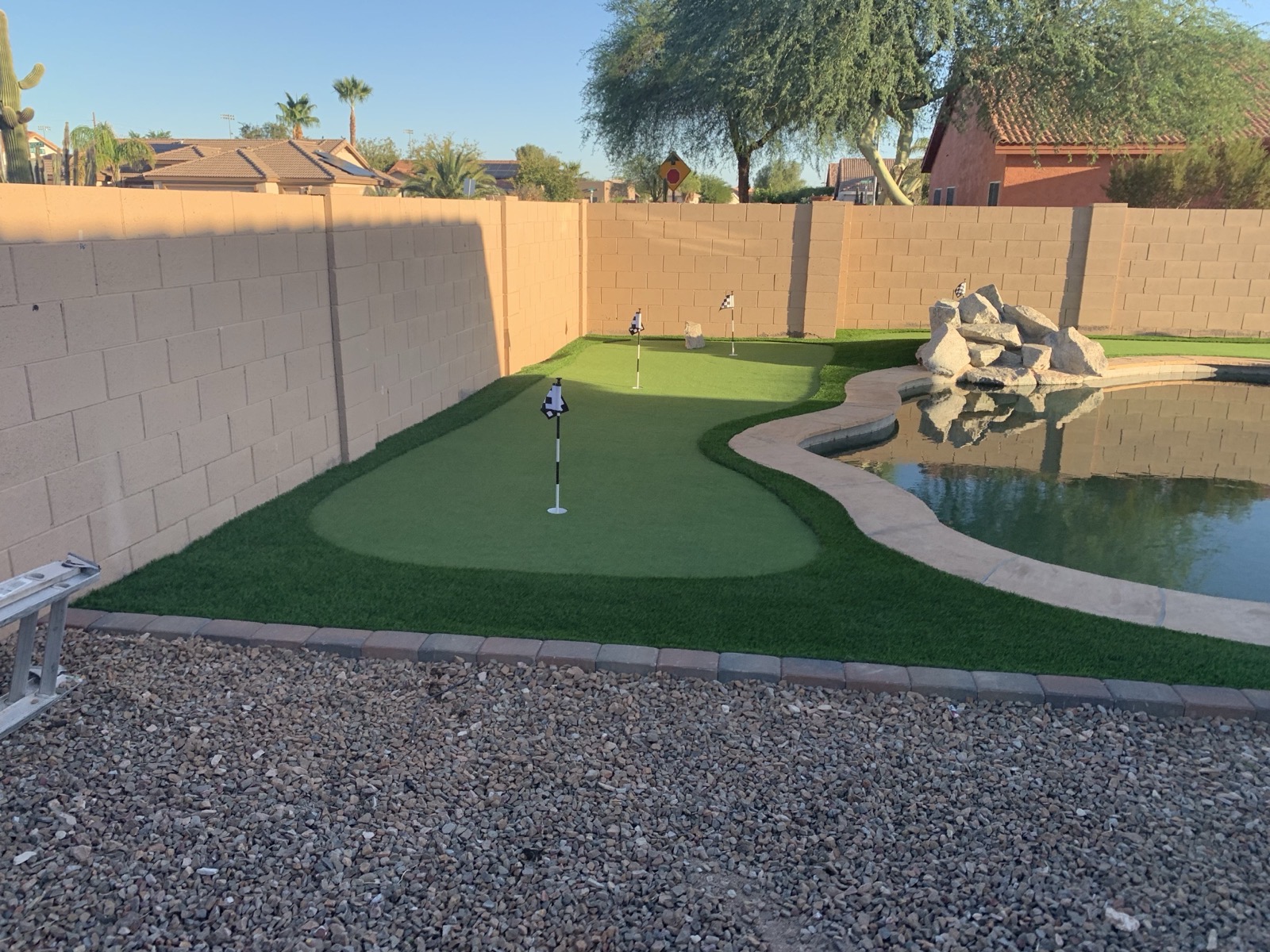
A backyard putting green cost in the Phoenix area usually lands around $18 per square foot installed for a professionally built synthetic green, which puts most residential greens somewhere between roughly $4,000 and $15,000 depending on size. The square footage sets the starting point; the base work, contouring, cups, and fringe decide whether the green actually rolls true.
National cost guides tend to quote a wide $15 to $40 per square foot range. That spread is not random. It reflects how much work goes under the surface, and in Arizona, the work under the surface is what separates a green you use for fifteen years from one you rip out after three summers.
The Short Answer
Plan on about $18 per square foot for a professionally installed backyard putting green in the Valley. A small 200-square-foot practice green runs around $3,600, a medium 400-square-foot green with two or three cups runs around $7,200, and a large 750-square-foot green with contours and chipping fringe can reach $13,500 or more. These are planning figures, not quotes -- access, demolition, drainage, and design all move the final number.
Backyard Putting Green Cost Per Square Foot Installed
Our planning figure for a putting green is $18 per square foot, compared with about $15 per square foot for standard landscape turf. The extra few dollars buy you two things that a regular lawn does not need:
- Putting surface turf. Putting turf is a short, dense, low-pile product designed to roll a ball smooth and straight. It is a different material from the softer, taller turf in a play lawn.
- A tighter base tolerance. A lawn can hide a small dip. A putting green cannot. The base has to be graded and compacted to a much finer finish so a ball does not wobble or drift where it should not.
If you see a putting green quote far below that range, ask what was left out. Usually it is base depth, compaction passes, or the infill that controls ball speed -- the exact things that make a green worth putting on.
For context on how standard lawn pricing works, see our Arizona artificial grass cost guide.
How Much Does a Small, Medium or Large Putting Green Cost?
Here is how sizes typically break down at the $18 per square foot planning figure:
Small greens (150 to 300 square feet): about $2,700 to $5,400
Enough for one or two cups and short lag putts. These fit side yards, a corner of a smaller backyard, or a strip between the patio and the wall. Great for daily practice on the three-to-eight-foot putts that actually save strokes.
Medium greens (300 to 600 square feet): about $5,400 to $10,800
The sweet spot for most Valley homeowners. Room for three cups, a gentle break or two, and enough length for real lag practice. A medium green also looks like a deliberate feature in the yard rather than an afterthought.
Large greens (600 to 1,000+ square feet): about $10,800 to $18,000+
Multiple tiers or pronounced breaks, four or more cups, and often a chipping area around the edges. Large greens are common in Scottsdale, North Phoenix, and golf-community homes where the owner plays several times a week.
Per-square-foot cost tends to hold steady on our end because the base prep and contouring scale with the area. What changes the total most is everything around the green, which brings us to the next section.
What Drives the Price of a Backyard Putting Green?
Two greens with the same footprint can be priced very differently. These are the factors that move the number:
- Base preparation. A proper green sits on several inches of compacted quarter minus aggregate, graded to drain and then finished to a tight tolerance. In Arizona, native caliche, rock, and old irrigation lines often have to be dug out first. This is the single biggest quality driver and the first thing a low bid cuts.
- Contouring and breaks. A flat green is simpler. Built-in breaks, ridges, and tiers take more base material and more hand-shaping time -- and they are what make a green fun to practice on.
- Number of cups. Each cup has to be set precisely level and flush with the surface. More cups mean more labor and more ways to practice different reads.
- Fringe and chipping areas. Most greens are framed by a collar of taller turf so you can chip on and so the green blends into the yard. That fringe is standard landscape turf at about $15 per square foot as a planning figure.
- Edging and borders. A paver border at about $12 per linear foot gives the green a crisp, finished edge and keeps rock and soil from migrating onto the putting surface.
- Access and demolition. Tight side gates, removing old grass or concrete, and hauling out spoils all add labor.
- Extras. Landscape lighting (about $450 per fixture) lets you putt after the sun goes down, which in a Phoenix summer is often the only comfortable time to be out there.
Do not forget shade
In July, a sun-blasted green is unusable by mid-morning. Placing the green near a SunGuard Shade Solutions patio cover or planning it around existing shade makes it a year-round feature instead of a winter-only one. Our guide on designing a putting green with the right shade coverage covers placement in detail.
DIY Putting Green Kit vs Professional Install
DIY putting green kits and roll-out mats are widely sold, and they are much cheaper up front. They are a reasonable fit for some people. They are not the same product as a built-in green, and it is worth being honest about the difference.
Where a DIY kit makes sense
- An indoor or garage practice mat
- A renter who needs something portable
- A small, flat practice strip set on an existing hard surface
Where DIY usually falls short in Arizona
- The base. Excavating, hauling, and compacting a stone base by hand is heavy, hot work, and getting it flat enough for a true roll takes equipment and experience most homeowners do not have. Without a proper base, the green develops dips that throw every putt off line.
- Heat and movement. Turf laid loose or poorly secured can expand, ripple, and lift at the edges in Arizona heat.
- Seams and cups. A visible seam or a cup that sits slightly high will affect every putt that crosses it.
- Drainage. Monsoon storms dump a lot of water fast. A green without a draining base can puddle and wash out.
- Warranty. A kit you install yourself has no installer standing behind the workmanship.
The real comparison is not kit price versus install price. It is the cost of a green that rolls true for years versus one you end up tearing out and paying to rebuild.
Why the Cheapest Putting Green Quote Is the Red Flag
Putting greens magnify shortcuts. A thin base shows up as a ball that breaks the wrong way. Skimped infill shows up as a green that is slow in one spot and fast in another. A rushed seam shows up as a hop.
At Green Forever Arizona, every green starts with a properly excavated and compacted quarter minus base, finished to a putting-green tolerance, with cups set level and the correct infill for consistent speed. Our crews have been with us since day one, we are a licensed Arizona contractor (ROC #324435), and our turf carries a 16-year materials warranty plus a 2-year labor warranty. That is what the $18 per square foot pays for, and it is exactly what a bid far below it is leaving out.
See Your Putting Green Before You Build It
Not sure what size fits your yard or where the green should go? Upload a photo to our free AI visualizer to preview turf and a putting green on your own property. When you are ready, book a free consultation and we will walk the yard, check grade and drainage, and give you a real number.
FAQ
How much does a 10x20 putting green cost?
A 10-by-20-foot green is 200 square feet, which works out to roughly $3,600 at our $18 per square foot planning figure. Fringe, a paver border, lighting, or difficult access would add to that.
Is a backyard putting green worth it?
For golfers who will use it, usually yes. Short putts are where most strokes are lost, and a green in the backyard turns ten minutes of practice into a daily habit. It also doubles as a finished, low-water landscape feature.
How long does a synthetic putting green last in Arizona?
A properly built green with quality turf and the right infill can last many years in the Arizona sun. Lifespan depends heavily on the base and materials, which is why build quality matters more than the initial price.
Can a putting green be added to an existing turf lawn?
Yes. A putting green is often built into a larger turf area, with the surrounding lawn acting as the fringe. Planning both together usually gives the cleanest transitions and the best drainage.
How much maintenance does an artificial putting green need?
Very little. Occasional brushing, blowing off leaves and debris, and topping up infill when needed keep the speed consistent. There is no mowing, watering, or fertilizing.