
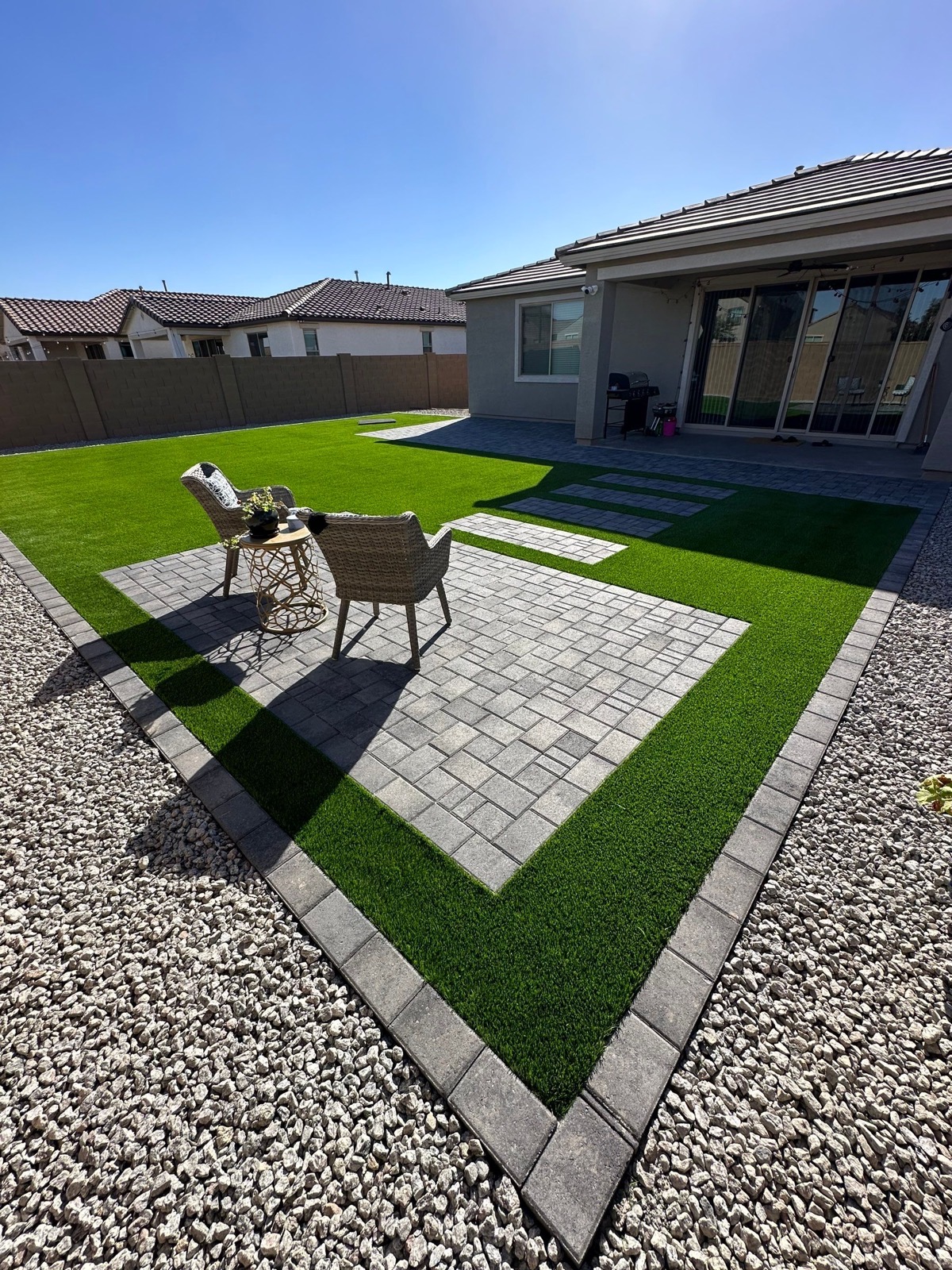
If you have a dog and you are researching artificial grass, you have probably already found the horror stories. Someone's backyard in Gilbert that smells like a kennel by August. A neighbor who tore their turf out after two summers because the side yard became unusable. The forum threads are real, and we are not going to pretend otherwise.
But here is what those stories almost never tell you: the yards that smell were not ruined by the dog. They were built wrong on day one, and the dog simply revealed it.
The Short Answer
Properly installed artificial grass does not smell, even with multiple large dogs, even in a Phoenix summer. Turf that smells is turf where urine has nowhere to go -- and that is a construction problem, not a pet problem.
Dog urine is mostly water. The ammonia and bacteria that produce the smell only become a problem when the liquid sits. On a correctly built lawn, urine passes through the turf backing, through the infill, through several inches of permeable base, and into the soil below in seconds. There is nothing left on the surface to bake in the heat. On a badly built lawn, that same urine pools in the backing or on a sealed sub-base, and 110 degrees does the rest.
So the honest question is not "does artificial grass smell with dogs." It is "was this particular lawn built to drain." Here is how to tell the difference, and how to make sure yours is the kind that does not.
Where the Smell Actually Comes From
When a homeowner calls us about a smelly yard someone else installed, it traces back to one of four things nearly every time. Usually it is more than one.
1. A base that does not drain
This is the big one. The turf fiber itself is inert plastic. It cannot hold odor any more than a patio chair can. What holds odor is whatever is underneath it.
A proper base is several inches of quarter minus aggregate, compacted in lifts, graded with a slight fall so water moves. It is porous, it is stable, and it carries liquid straight down and away. A cheap install skips depth to save on material and hauling, or compacts a single thin lift over native caliche clay that water cannot penetrate. Urine hits that layer and stops. The lawn above it becomes a sponge sitting in a puddle, and by mid-July it announces itself every time you open the back door.
You cannot see base depth after the turf goes down. That is exactly why it is the first thing a lowball bid quietly cuts.
2. The wrong backing
Turf is manufactured with drainage holes punched through the backing, and the spacing of those holes varies wildly by product. Budget turf is often perforated every few inches, which is fine for rain and useless for a dog who returns to the same corner twice a day. The urine lands between holes and sits in the backing fabric.
Pet-grade turf uses a fully permeable backing that drains across its entire surface, not just at the holes. If a contractor cannot tell you the drainage rate of the product they are quoting, that is a product they picked on price.
3. The wrong infill, or not enough of it
Infill is the granular material brushed into the fibers after install. It does three jobs: it holds the blades upright, it protects the backing from UV, and it manages what passes through. Plain silica sand is cheap and does the first two jobs. It does nothing about ammonia, and in a dog yard it can actually trap it.
For pet lawns we use infill designed to neutralize odor-causing bacteria rather than host it. And the rate matters as much as the type -- an under-filled lawn is invisible on install day and obvious a year later when the fibers lie flat and the surface holds moisture instead of shedding it. Cutting infill is one of the easiest ways to shave a few hundred dollars off a quote, which is why it happens constantly.
4. No one ever rinsed it
Even a perfectly built lawn is not maintenance-free with dogs. It is low-maintenance. A quick hose-down of the high-traffic spots once a week in summer, and an enzyme-based turf cleaner once a month, is the entire routine. Skip it for a whole season and even good turf will start to tell on you. Our guide to turf cleaning and pet urine odor control covers the routine in detail, and the short version is that it takes less time than mowing ever did.
Why the Cheapest Quote Is the One That Smells
We want to be direct about this, because it is where most odor problems are actually born.
Artificial grass for dogs has become a popular enough category in the Valley that there is now a race to the bottom on it. When you get three quotes and one is dramatically below the other two, that gap is not margin the contractor decided to give you. It is base depth, backing quality, infill rate, and crew time -- the four things that decide whether your yard smells in August.
Here is what to ask every bidder, in writing:
- How many inches of base, and what material? The answer should be a specific number and the words "quarter minus." A vague "a few inches of gravel" means they have not decided yet, and they will decide on the cheap side.
- What is the backing drainage rate on the exact product you are quoting? Pet turf should be fully permeable, not hole-punched.
- What infill, and how many pounds per square foot? You want an odor-neutralizing infill at the manufacturer's full recommended rate, not sand because it was on the truck.
- Who is on the crew? Pet-grade installs demand clean seams and a flawless grade. A crew that was hired last month does not know what a dog corner needs.
- What is your ROC number? An unlicensed installer has nothing standing behind the lawn when it fails in year two.
Green Forever Arizona is a licensed Arizona contractor (ROC #324435). We install U.S. sourced turf, our installs carry a 2-year labor warranty, and the turf itself is backed separately by a 16-year materials warranty. The crews on your property have been with us since day one, and they have built more dog yards in this heat than anyone we know of. For help choosing the right product in the first place, our guide to the best artificial grass for pets walks through face weight, pile height, and backing in plain English.
What a Pet Lawn Costs
As a planning figure, quality artificial turf installed properly runs about $15 per square foot in the Valley. Pet-specific lawns typically land at the upper end of normal because of the deeper base and specialized infill, but they do not jump to a different tier. If a bid is coming in well under that, the question is not what you are saving. It is what was left out.
Those are planning numbers, not quotes -- real pricing depends on access, demolition, drainage, and layout. For the full breakdown, see our 2026 artificial grass price guide.
A Few Design Choices That Make Dog Yards Easier
Beyond construction, a little layout thinking goes a long way.
- Give the dog a corner. Most dogs pick a spot and return to it. A designated run along a side yard, graded to drain and built with the full pet spec, concentrates the maintenance into one easy-to-rinse zone.
- Add a hose bib or drip line nearby. If rinsing is a ten-second job, it happens. If it means dragging a hose across the whole yard, it does not.
- Border the turf with pavers, not dirt. A clean paver border at about $12 per linear foot keeps mud and loose soil from migrating onto the lawn, which is a surprisingly common source of "it smells" calls that are actually about tracked-in dirt.
- Keep shade in the plan. Surface temperature affects how fast anything on the lawn dries and how pleasant the space is for the dog. A SunGuard Shade Solutions patio cover over the main living area and strategic turf placement keep the yard usable through the afternoon.
See It on Your Own Yard First
Before you decide anything, see what it would actually look like. Upload a photo of your yard to our free AI visualizer and preview turf on your real property in seconds -- no appointment, no pressure.
When you are ready for a real number, schedule a free consultation. We will walk the yard with you, look at where the dog actually goes, check the grade and the soil, and spec the base, backing, and infill to make sure the only thing your lawn smells like in August is nothing at all.