
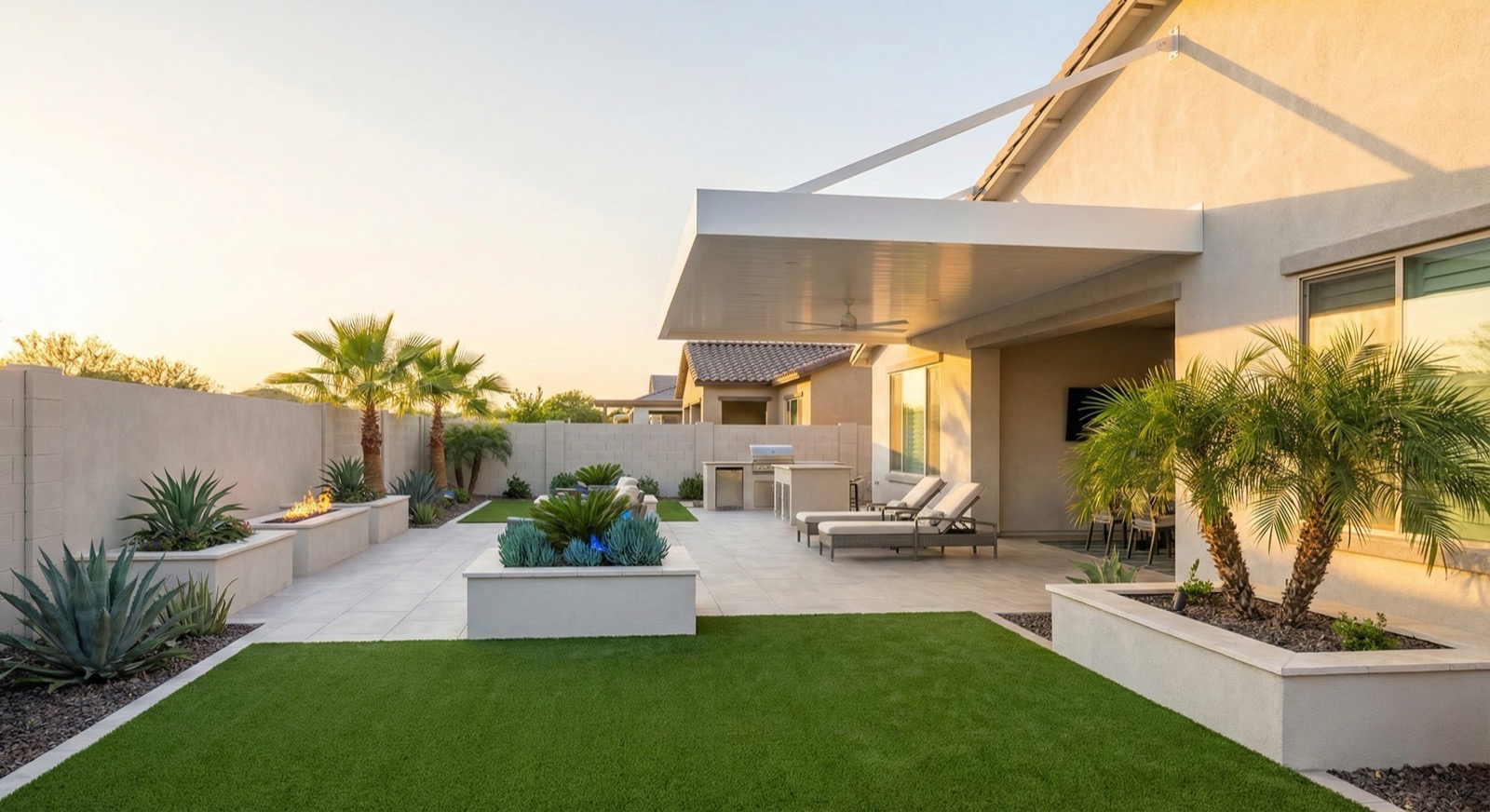
If you have started gathering paver quotes, you already know how confusing it gets. One contractor throws out a number that sounds like a steal, the next comes in nearly double, and nobody walks you through why. This guide lays out what a paver patio actually costs in Arizona, what moves the price up or down, and how to tell the difference between a bid that saves you money and one that will cost you a second install a few years from now.
What Pavers Cost in Arizona
Here is the honest range most companies will not put in writing: installed paver work across the Valley runs anywhere from around $12 per square foot on the low end to $25 or more per square foot for a patio built the right way. That is a wide spread for what looks like the same stone on the surface -- and that gap is the whole story.
A cheap bid and a quality bid are almost never the same job. The difference lives in the base underneath the pavers, the edge restraint that holds everything together, and the crew laying it. As a realistic planning figure, budget around $20 per square foot for a professionally installed paver patio or hardscape. A decorative paver border prices separately at roughly $12 per linear foot, and if you are pairing pavers with a rock ground cover, decorative rock runs about $3.50 per square foot installed.
For a quality, professionally installed project, here is what most Arizona homeowners can expect:
- A 300 sq ft paver patio: roughly $6,000 to $7,500
- A 500 sq ft entertaining patio: roughly $10,000 to $13,000
- A paver walkway or side-yard path (150 sq ft): roughly $3,000 to $4,000
Treat these as planning figures, not a quote -- every yard is different, which is exactly why a real price requires a free on-site measurement. You can also preview your own patio before you spend a dime using our free AI visualizer.
What Actually Drives the Price
The square-foot range above swings based on a handful of factors. Understanding them helps you read any bid you receive and spot where you are paying for real value versus filler.
1. Base Preparation
This is the part homeowners never see and corner-cutting contractors love to skip. A proper paver installation starts underground: excavating several inches of soil, then building and compacting an aggregate base that gives the pavers a stable, well-draining foundation. In Arizona, where expansive soils shift and monsoon storms dump water fast, that base is the single biggest reason a patio stays flat instead of heaving, sinking, and turning into a tripping hazard. A suspiciously cheap bid almost always means thin base work -- and thin base work is the number-one reason paver patios fail.
2. Paver Material and Quality
Not all pavers are equal. Thickness, density, and color-fastness all matter. Premium pavers hold their color and structural integrity through relentless UV and 115-degree summers, while bargain pavers fade, spall, and crack. Travertine, porcelain, and high-grade concrete pavers each carry different price points and each performs differently in the heat -- we break that down in our guide to the best pavers for hot climates in Arizona.
3. Edge Restraint and Sand Joints
The stuff that keeps a patio from spreading apart is invisible when it is done right. Quality installs use proper edge restraints and, increasingly, polymeric joint sand that locks the pavers together and resists weeds and ants. Skip these -- another classic corner cut -- and the field starts shifting and gapping within a couple of seasons.
4. Project Size and Layout
Larger, open areas usually cost less per square foot because crews work more efficiently across uninterrupted space. Small, chopped-up designs with lots of curves, borders, inlays, and tight corners take far more cutting and labor, which raises the per-foot price even when the total footage is modest.
5. Site Conditions and Access
Sloped lots, existing concrete that has to be demolished and hauled off, poor drainage, and hard-to-reach backyards all add labor. A flat, open space with easy gate access is the most affordable scenario. Tearing out an old cracked slab first will always add to the number.
6. Add-Ons and Features
Many Arizona homeowners build the patio as the anchor for a larger outdoor project, and these affect the total:
- Paver borders to frame turf, a patio, or a driveway run about $12 per linear foot
- Landscape lighting to make the space usable after sunset runs roughly $450 per fixture installed
- Artificial turf inlays or surrounding lawn price separately (turf runs around $15 per square foot)
- A SunGuard Shade Solutions patio cover turns the patio into a room you can actually use in July
Pavers vs. Concrete: The Real Long-Term Math
The most common question we hear is why not just pour a concrete slab, since a plain slab often looks cheaper up front. The answer is what happens over the next ten years in Arizona soil.
Concrete is a single rigid sheet. When the ground moves -- and in the desert it always does -- concrete cracks. Once it cracks, you cannot invisibly repair it; you patch it, live with it, or pay to demolish and repour the whole thing. Pavers are individual units sitting on a flexible base, so they move with the soil instead of fighting it. If a section ever settles or a single paver gets stained, that unit lifts out and gets reset or replaced -- no jackhammer, no seams, no mismatched patch.
Add in that pavers deliver a higher-end look that lifts curb appeal and resale value, and the slightly higher upfront cost usually wins the long game. You are not just buying a surface; you are buying one you can maintain and repair piece by piece for decades.
Why the Cheapest Bid Is Usually the Most Expensive
It is tempting to chase the lowest number, but with pavers the cheapest bid is almost always the most expensive decision you can make. Here is why a rock-bottom price should be a red flag, not a win:
- Thin or skipped base prep -- the top corner cut on cheap jobs -- leads to sinking, heaving, wavy surfaces, and pooling water within a season or two.
- Bargain pavers fade, spall, and crack under UV and heat while quality stone still looks new years later.
- No edge restraint or cheap joint sand lets the field spread, gap, and grow weeds through every seam.
- Inexperienced or rushed crews leave uneven lippage, sloppy cuts, and drainage that funnels water toward your house instead of away from it.
- No real warranty means when the patio fails, the full cost of tearing it out and starting over lands squarely on you.
When a patio installed on the cheap fails in two or three years, you do not simply pay again -- you pay to remove the failed install first, then pay for the quality job you should have had from the start. That is exactly why so many of our projects are replacing someone else's bargain hardscape.
The right question is never "what is the lowest price today?" It is "what is the lowest cost per year over the life of this patio?" A properly built paver space that stays flat, drains right, and looks great for decades wins that math against a cheap one you replace twice.
How to Make a Premium Patio Affordable
The smart move is not to find the cheapest pavers -- it is to make a quality project fit your budget. A few ways to do that without cutting corners:
- Ask about financing. Green Forever Arizona offers financing that spreads the investment into manageable monthly payments.
- Phase the project. Start with the highest-impact area -- the main entertaining patio or the front walkway -- and expand over time.
- Combine projects. Installing pavers, turf, and a patio cover together is more efficient than scheduling separate jobs since the crew is already mobilized. Our guide to affordable backyard upgrades walks through how the pieces fit.
- Get a real measurement. Online estimates are guesses. A free on-site visit gives you an exact, no-obligation number so you can plan with confidence.
What's Included in a Green Forever Arizona Quote
When you get a quote from us, the price reflects the whole job done right: full excavation and a properly compacted aggregate base, quality pavers, correct edge restraint and joint sand, clean cuts, drainage graded away from your home, materials backed by a 16-year warranty, and our workmanship backed by a 2-year labor warranty (ROC #324435). No surprise add-ons, and no thin base prep that costs you later.
Get Your Real Number -- Free
The honest answer to "how much do pavers cost in Arizona" is: it depends on your yard, your material, and how much of the work happens where you can see it. But a quality paver patio -- built on a real base, by an experienced crew, with a warranty behind it -- is one of the best-value upgrades you can make to a desert home. The best next step is a free, no-pressure consultation where we measure your space and give you an exact price. Want to see it first? Try our free AI visualizer, then explore how a SunGuard Shade Solutions patio cover can turn your new patio into a room you use all year.
Get an Exact Price for Your City
Paver costs vary by yard, which is why we hand-measure for free and quote exact. We serve the whole Valley, including Mesa, Gilbert, Peoria, Goodyear, and Scottsdale. Or see your yard transformed first with the free AI Visualizer.