
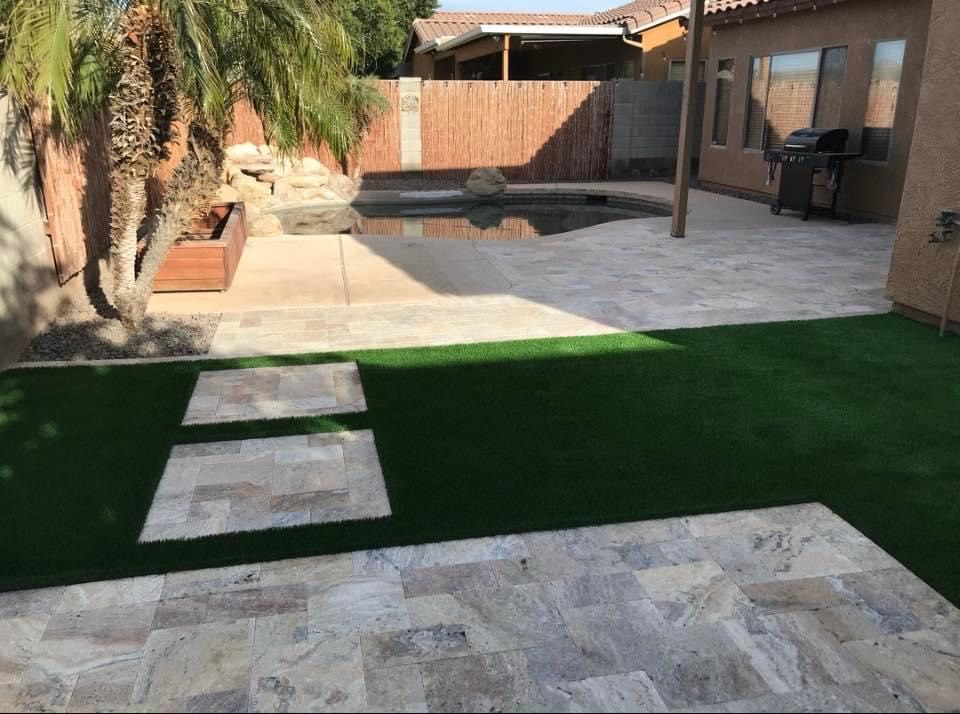
Almost every backyard project in the Valley eventually arrives at the same fork in the road: pour a concrete slab, or lay pavers. The bids look very different, the finished spaces look very different, and ten years later they age in completely different directions. This is the comparison we walk homeowners through in person every week -- what Arizona specifically does to each surface, what each one really costs once you count the second decade, and how to read the quotes in front of you.
The Short Answer
Concrete is cheaper to pour. Pavers are cheaper to own -- and in Arizona soil, dramatically easier to live with.
That is not a slogan, it is a consequence of how the two systems are built. A concrete patio is one large, rigid plate. Our ground is not rigid. Pavers are hundreds of small units sitting on a compacted aggregate base, and that system is designed to move a little without failing. In a climate with expansive clay soils, 110-degree summers, and monsoon storms that dump an inch of water in forty minutes, "designed to move a little" turns out to matter enormously.
What Arizona Does to a Concrete Slab
Expansive Soil and the Crack You Cannot Un-See
Much of the Phoenix metro sits on soils that swell when they get water and shrink when they dry out. That cycle happens every monsoon season, every irrigation change, every winter rain. A poured slab has no way to absorb that movement -- so it relieves the stress the only way it can, by cracking.
Contractors know this, which is why slabs get control joints: deliberate weak lines that try to steer the crack somewhere tidy. They help. They do not always win. Talk to enough Valley homeowners and you will find slab cracks that wander straight across the middle of the patio, and settling that leaves one corner half an inch lower than the rest. It is not necessarily bad workmanship. It is a rigid material on ground that refuses to hold still.
Heat, Glare, and the Afternoon Slab
A large expanse of light gray concrete does two things in an Arizona summer: it absorbs heat all afternoon and radiates it back at you into the evening, and it throws glare off the back of the house. Pavers are not magic -- any hardscape in direct August sun gets hot -- but the color options, the texture, and the joints between units make a real difference in how the space reads and feels. Our guide to the best pavers for hot climates in Arizona goes deeper on which colors and materials to choose if summer comfort is your priority.
Repair Is the Real Problem
Here is the part that catches homeowners off guard. When a slab cracks, chips, or stains, there is no clean fix. Patch compound never matches. Resurfacing is a whole project and eventually fails at the same joint. Cutting out a section leaves a visible seam forever. And if you ever need to run a gas line, a drain, or a pool plumbing repair under that patio, the slab gets jackhammered out and re-poured -- and the new concrete will never match the old.
Why Pavers Behave Differently Here
A Flexible System, Not a Single Plate
A proper paver patio is an engineered assembly: excavation, several inches of compacted quarter-minus aggregate base, a precise bedding layer, the pavers themselves, edge restraint around the perimeter, and joint sand locking it all together. When the soil below moves, the base distributes the load and the individual units shift microscopically against each other instead of fracturing. The surface stays a surface.
That same structure is why pavers handle monsoon water better. Rain moves down through the joints into the base and away, rather than sheeting across a solid slab toward your foundation or pooling in the low spot the slab settled into.
Any Single Paver Is Replaceable
This is the quiet advantage that homeowners appreciate most in year eight. Oil drip from the grill? A tree root you did not plan for? A plumber who needs access to a line? You lift the affected pavers, do the work, and set them back. There is no seam, no patch, no color mismatch -- because you are reusing the exact same units, from the exact same batch, that were there the day it was installed.
It is worth keeping a small stack of extras from your job tucked behind the shed for exactly this reason. Try that with a slab.
It Looks Like a Designed Space, Not a Pour
Concrete has one visual mode. Pavers have pattern, color blends, borders, banding, and shape. A crisp paver border around a turf lawn, a herringbone field around a fire pit, a soldier course framing the back door -- these are the details that make a backyard look designed rather than poured. Add low-voltage lighting into the hardscape and the space works after sunset too.
The Money Conversation, Honestly
Let's put real planning figures on the table, because this is where most comparisons get evasive.
- Poured concrete typically lands somewhere in the $8 to $14 per square foot range in the Valley for a properly prepared patio slab, depending on thickness, reinforcement, and finish. Stamped or colored work runs higher.
- A quality paver patio runs about $20 per square foot as a planning figure -- that includes excavation, the compacted base, the bedding layer, the pavers, edge restraint, and polymeric joint sand, installed by a crew that does this every day.
So yes: concrete is the lower number on install day, and we are not going to pretend otherwise. The question is what happens after that.
Concrete's number is a first cost that becomes a repair budget. Cracks, settling, resurfacing, and eventual replacement are not edge cases here -- they are the normal Arizona life cycle of a slab. Pavers cost more on day one and then mostly ask to be swept and occasionally re-sanded. Over fifteen or twenty years, the paver patio is routinely the cheaper surface, and it is the one that still looks like the day it went in.
Our 2026 paver price guide breaks the hardscape number down line by line if you want to see exactly where the money goes.
Where a Cheap Paver Bid Hides Its Discount
If you have three paver quotes and one is dramatically lower, the money did not vanish. It came out of the parts of the job you will never see once the pavers are down. Ask about these five things specifically:
- Base depth and compaction. This is the foundation of the entire system and the first corner cut on a low bid. Thin base, or base dumped in and never properly compacted in lifts, means a patio that ripples and dips within a few seasons. Ask how many inches, and ask how it gets compacted.
- The bedding layer. There is a right material and a right thickness under the pavers. Too much bedding sand, or the wrong aggregate, and the surface goes wavy no matter how nice the pavers are.
- Edge restraint. Without a proper restraint around the perimeter, the field slowly spreads outward and the joints open. It is inexpensive to do and catastrophic to skip.
- Polymeric joint sand. Cheap installs use plain sand, which washes out in the first monsoon and invites weeds and ants into every joint.
- License and accountability. Ask for the ROC number. An unlicensed crew has nothing standing behind the work if the patio fails in year two.
The lowest bid on the counter is not the budget option -- it is the bid most likely to have you paying for the same patio twice. Green Forever Arizona is a licensed Arizona contractor (ROC #324435), our installations carry a 2-year labor warranty, and the crews building your patio are the same experienced crews who have been with us since day one. If you are also putting in turf, that lawn is backed separately by a 16-year materials warranty.
When Concrete Is Actually the Right Call
We would rather be straight with you than sell you something you do not need. Concrete makes real sense when:
- You are pouring a utility area -- a shed pad, an AC pad, a side-yard walkway nobody looks at
- The budget genuinely will not stretch, and the alternative is doing nothing for three years
- You need a perfectly monolithic surface for a specific use
For the main patio -- the space your family actually lives in, the one that sets the tone for the whole backyard -- pavers are the surface we recommend in this climate, and it is not close.
See It on Your Own House First
The fastest way to settle this is to look at it. Upload a photo of your yard to our free AI visualizer and preview pavers on your actual patio in seconds -- no appointment, no pressure. Most homeowners find the decision makes itself once they see the pattern and color against their own house.
And if you are shading that patio anyway, plan both at once. A SunGuard Shade Solutions patio cover over new pavers is the single most-used combination we build in the Valley, because it turns an unusable summer slab into the part of the house everyone ends up in.
When you want a real number instead of a planning figure, schedule a free consultation. We will measure, walk the space with you, talk through pattern and base depth, and give you an exact quote -- so you can compare bids knowing precisely what is underneath each one.